Why the 90-Day Fill Is the Quiet Workhorse of Canadian Prescription Savings
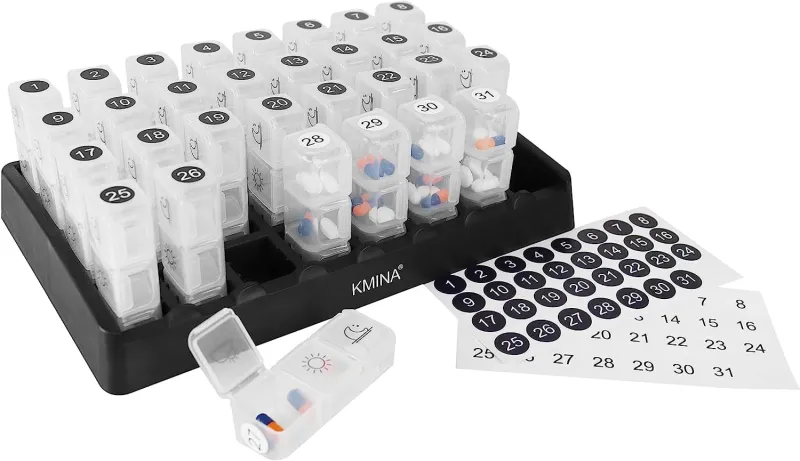
Photo: three month prescription pill organizer calendar refills, via i5.walmartimages.com
When patients compare American and Canadian drug prices, they tend to focus on the unit price — the cost per tablet, per vial, per inhaler. That number matters, but it is not the whole equation. Every cross-border order carries fixed costs and fixed risks: a shipping fee, a dispensing fee, a delivery window, and a small chance of customs delay. The fewer orders you need per year, the more of the headline savings you actually keep.
That is why the 90-day supply is, for many patients, the single most effective lever in cross-border shopping.
How Quantity Rules Shape the Math
Licensed Canadian pharmacies dispensing to American patients generally require a valid prescription and ship personal-use quantities, commonly up to a 90-day supply. That limit exists for good reason — it signals the medication is for the patient, not for resale — but it also defines the ceiling of your savings.
Consider the structure. If a pharmacy charges a flat shipping fee and a dispensing fee per order, a patient placing four 30-day orders per year pays those fees four times. A patient placing one or two 90-day orders pays them once or twice. On a $40 shipment fee, that difference alone approaches $120 annually — before accounting for the reduced risk of a delayed package disrupting a monthly routine.
Which Medications Suit a 90-Day Fill
Bulk ordering works best for medications that are stable, predictable, and well-tolerated:
- Chronic, stable conditions. Blood pressure medications, statins, thyroid replacements, and most oral diabetes agents fit the profile: consistent dosing, infrequent adjustments.
- Maintenance medications with a long track record. If you and your prescriber have not changed the dose in over a year, a 90-day supply is usually reasonable.
- Non-refrigerated tablets and capsules. Room-temperature-stable medications travel without cold-chain concerns.
Which Require Closer Monitoring
Some prescriptions argue for shorter fills:
- Medications in titration. If your prescriber is still adjusting your dose, a 90-day stockpile of the wrong strength is money in the trash.
- Temperature-sensitive products. Insulin and certain biologics can ship cold-chain, but smaller, more frequent orders reduce time in transit. Some pharmacies limit quantities for this reason.
- Medications requiring routine labs. Drugs that need periodic blood monitoring are often better paired with shorter fills until your results are stable.
- As-needed medications with changing use patterns. If your usage fluctuates, a large fill may expire before you use it.
Talking to Your Prescriber About Fill Size
Many American prescriptions are written as 30-day fills by default, not by medical necessity. If you plan to order from a Canadian pharmacy, raise the topic at your next appointment. A practical script:
"I'm ordering my maintenance medications from a licensed Canadian pharmacy to manage costs. They can dispense up to a 90-day supply with refills. Could you write the prescription with quantities and refills that support that?"
Most prescribers will accommodate this for stable maintenance therapy — and many will appreciate that you are being proactive about affordability, since cost-related nonadherence is a problem they see daily.
Timing Refills Around the Calendar
A 90-day supply changes your refill rhythm, and the timing of each order matters. Order when you have at least 30 days of medication on hand. This gives you room for a standard 10-to-14-day delivery window plus an unexpected customs hold. Patients who order at the last minute convert a routine delay into a dangerous gap.
It is also worth synchronizing multiple prescriptions into a single shipment where the pharmacy allows it, collapsing several fees into one.
The Bottom Line
The 90-day fill will not cut the sticker price of any single tablet. What it does is reduce the per-order overhead, lengthen the safety margin around shipping, and cut the number of times per year something can go wrong. For stable, long-term medications, it is the closest thing cross-border shopping has to a compounding advantage — and it starts with a conversation with your prescriber, not a checkout page.